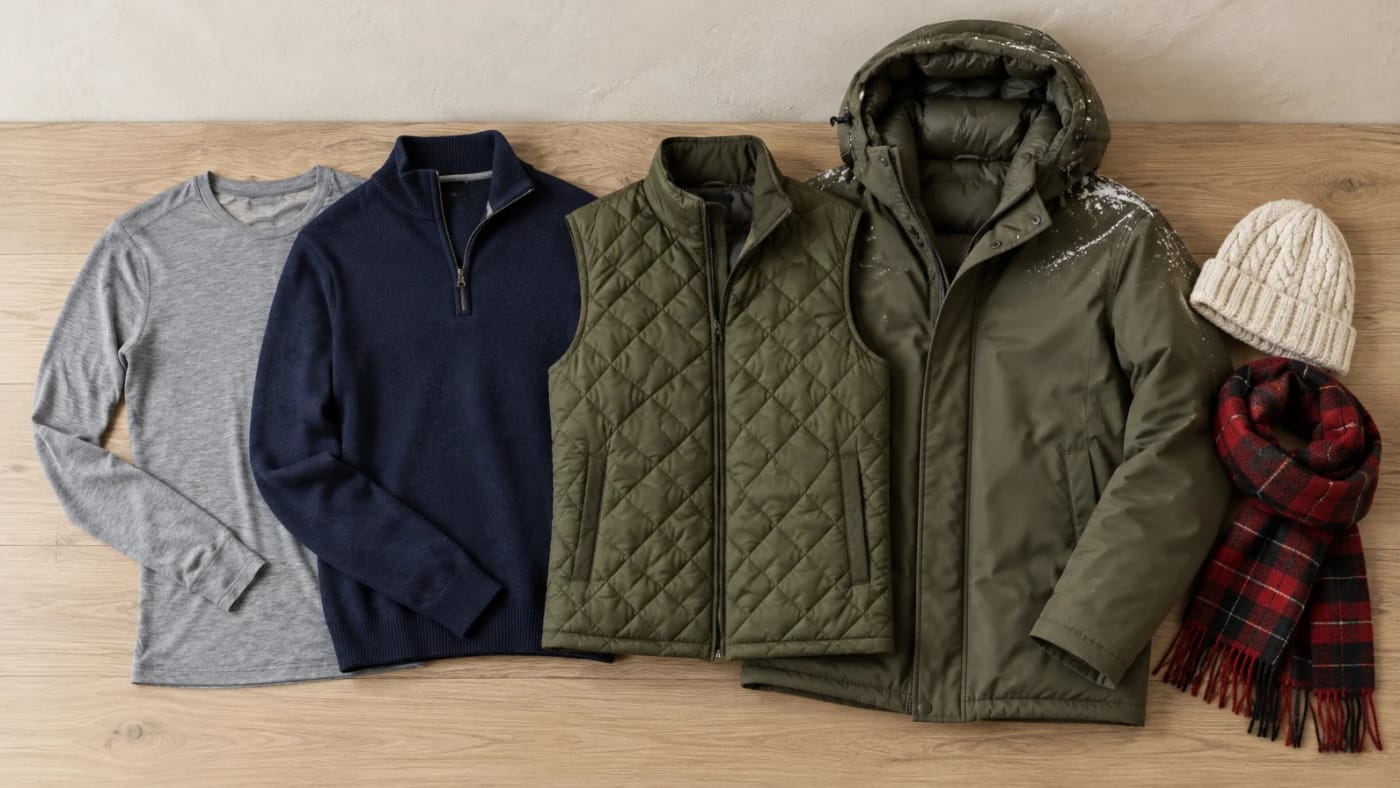
A Canadian winter asks a lot of clothing. The same day can start with a windchill well below freezing, move into an overheated bus or office, and end with wet snow on the walk home. One heavy coat can't handle all of that. Layers can. The idea is simple: several thinner garments, each with its own job, that you can add or take off as conditions change.
Here is how the three classic layers work, what each one is for, and how to put them together for a city day, a cold commute or an afternoon outside.
Why layering works
Warmth comes from still air trapped close to your body. Several layers trap more air than one thick one, and they let you adjust. Just as important is moisture: if sweat stays against your skin, it cools you quickly once you stop moving. A good layering system moves moisture away from the skin, holds warm air in the middle and keeps wind and wet out.
The base layer: next to the skin
The base layer manages moisture. It should fit close without being tight, so it can draw sweat away from the skin.
- Merino wool is a strong choice. It stays warm when damp, it's soft enough to wear against the skin, and it resists odour, so it can be worn more than once between washes.
- Synthetic base layers dry quickly and suit high-effort activity.
- Cotton is the one to avoid as a base layer on cold, active days. It holds sweat and dries slowly, which leaves you chilled. A cotton T-shirt under a sweater is fine for an office day; it's a poor choice for a long snowy walk.
The middle layer: insulation
The middle layer traps warm air. It's the one you're most likely to take off indoors, so it should be easy to remove.
- Wool knitwear: a crewneck or turtleneck sweater, a quarter-zip, a cardigan. A quarter-zip or a cardigan lets you vent heat without taking it off.
- Flannel shirts and overshirts: a cotton flannel or a corduroy overshirt over a base layer works for milder days, or as a layer under a heavier sweater.
- Vests: a quilted vest keeps your core warm while leaving your arms free, and it adds warmth under a coat without bulk in the sleeves.
On very cold days, two thin middle layers are often more comfortable than one thick one: a fine merino sweater under a vest, for example.
The outer layer: wind, snow and rain
The outer layer protects everything underneath. What you need depends on the day.
- Down or insulated parkas are the warmest option for deep cold. A hood, a two-way zip and a length that covers the hips make a real difference when the wind picks up. Down works best when it's dry; on wet days, look for a water-resistant shell fabric.
- Puffer jackets are lighter and pack down small. They suit active days and milder cold, and many fit over a sweater.
- Wool and wool-blend coats are warm and suit city days and dressier outfits. They block less wind than a technical parka, so add a warmer middle layer on windy days.
- Waxed canvas and denim jackets belong to the shoulder seasons. A waxed jacket sheds light rain and wet snow; with a thick sweater underneath, it covers a mild late-autumn or early-spring day.
Leave room under the outer layer. A coat that fits snugly over a T-shirt will compress the sweater underneath it, and compressed insulation keeps you less warm.
Head, neck and hands
A lot of comfort comes from covering the extremities.
- A toque keeps your head and ears warm. A folded cuff gives a double layer over the ears.
- A scarf closes the gap at the collar where cold air gets in. Wool scarves stay warm even when snow melts on them.
- A large shawl can work as a scarf outdoors and as a light extra layer indoors.
- Mittens are warmer than gloves because your fingers share their warmth. Gloves are better when you need dexterity.
Putting it together
Office day, cold commute. A cotton shirt or a merino base, a wool sweater or cardigan, a wool coat, a scarf and a toque. Indoors, the coat and scarf come off and the sweater stays on.
Very cold, windy morning. A merino base layer, a fine merino sweater, a quilted vest, a hooded down parka zipped to the chin, a toque, a scarf and mittens.
Afternoon outdoors, moving a lot. A merino or synthetic base layer, a quarter-zip you can open as you warm up, and a puffer jacket. Carry a dry toque if you sweat through the first.
Wet late-autumn day. A flannel shirt or a corduroy overshirt over a T-shirt, a cable-knit sweater on colder mornings, and a waxed canvas jacket.
Small habits that help
- Open zips and remove a layer as soon as you start to feel warm, before you sweat.
- Put layers back on as soon as you stop moving, while you're still warm.
- Dry boots, mittens and toques fully between uses.
Knitwear, outerwear and accessories from the marketplace's sellers are in the shop.